
What ISO 27001 Means for Software Development Teams
When critical knowledge sits with one developer, it creates risk for the entire organisation. This article explores how development teams can use internal documentation, wikis, and structured knowledge sharing to improve collaboration, onboarding, and long-term project stability.
Want to make your Microsoft 365 work harder for your business?
and we’ll tailor a solution that’s just right for you.
What ISO 27001 Means for Software Development Teams
For many software companies, ISO 27001 certification sits somewhere on the long-term roadmap, important in principle but easy to defer when immediate project work takes priority. That changes quickly the moment a prospective client asks for it, or when an internal security incident makes clear just how much undocumented risk has quietly accumulated.
Completing ISO 27001 certification is one of the most meaningful things a software development organisation can do for its information security posture. Not because it unlocks a certificate to display on the website, but because the process of achieving and maintaining it fundamentally changes how an organisation identifies, manages, and responds to security risk. This post explains what the standard involves, what completing it actually requires, and why it matters for the teams building and maintaining software systems.
What Is ISO 27001?
ISO 27001 is the internationally recognised standard for information security management systems, known as an ISMS. Published by the International Organisation for Standardisation, it provides a systematic framework for managing sensitive information to keep it secure. That includes financial data, personal data, intellectual property, and any other information whose loss, theft, or corruption could cause harm.
Rather than prescribing specific technical controls, ISO 27001 takes a risk-based approach. Organisations identify what information they hold, assess the risks to that information, and implement appropriate controls to manage those risks. Certification is awarded by an accredited third-party auditor and requires ongoing maintenance to keep the status valid.
| In plain terms ISO 27001 certification means an organisation has demonstrated, to an independent external auditor, that it has a structured, documented, and actively maintained approach to protecting information. It is not a guarantee that nothing will ever go wrong. It is evidence that the organisation takes security seriously and has the processes in place to manage it responsibly. |
Why Organisations Pursue ISO 27001 Certification
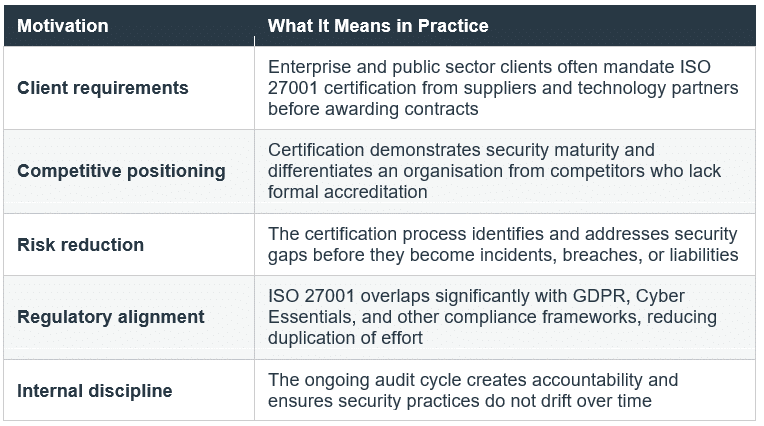
For some organisations, certification is a regulatory or contractual requirement. Government contracts, healthcare systems, and financial services clients increasingly require their technology partners to hold ISO 27001 or an equivalent standard. For others, it is a competitive differentiator and a signal of maturity to prospective clients.
Beyond the external benefits, the process of achieving certification has genuine internal value. It forces organisations to examine their own practices critically, identify gaps they may not have known existed, and build consistent, repeatable processes around security. Many organisations find that going through the process surfaces risks that were already present but unaddressed.
What Internal Audits Actually Involve
An internal audit is one of the core mechanisms by which an organisation maintains its ISO 27001 certification between external reviews. Having a trained internal auditor, as Danny now is, means the organisation can assess its own compliance systematically rather than waiting for an external body to identify gaps.
An internal audit involves reviewing whether the controls defined in the ISMS are actually being followed in practice. It is not about catching people out. It is about checking that the processes documented on paper reflect what happens in reality, and identifying where they do not so they can be addressed.
| What an internal audit typically covers Access control reviews to check who has access to what systems and whether those permissions are still appropriate. Incident log reviews to verify that security events are being recorded and responded to correctly. Documentation checks to confirm that policies are current, approved, and understood. Risk register reviews to ensure identified risks have assigned owners and mitigation plans. Training records to verify that staff have completed required security awareness training. |
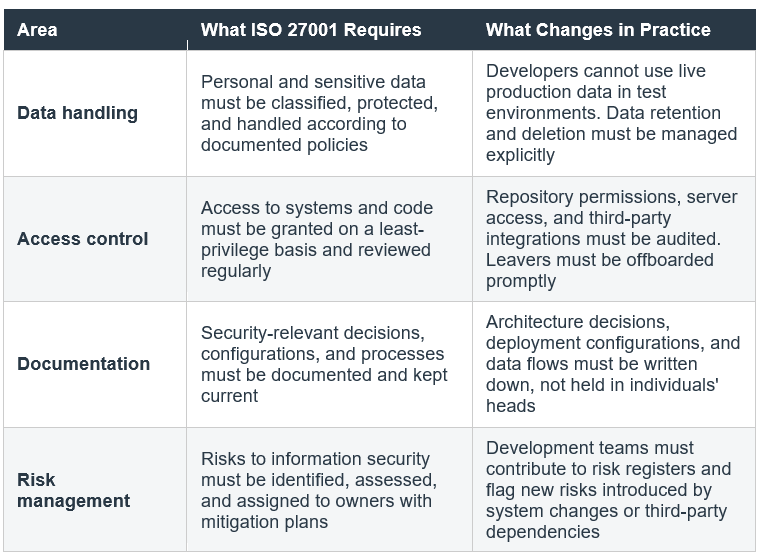
How ISO 27001 Affects Development Processes
The case for investing in documentation is not just about avoiding disasters. There are clear, measurable benefits for businesses that get this right.
Security Controls and What They Mean for Development
ISO 27001 references a set of controls, currently defined in Annex A of the standard, that organisations can implement to address information security risks. Not every control applies to every organisation. The standard requires that organisations select controls relevant to their risk profile and document why others have been excluded.
For a software development company, the controls most directly relevant include:
- Secure development policy: documented standards for how software should be written and reviewed
- Change management: a controlled process for making changes to systems, with appropriate testing and approval
- Protection of test data: ensuring that realistic or sensitive data is not used in development or testing environments
- Vulnerability management: a process for identifying, assessing, and addressing security vulnerabilities in code and infrastructure
- Supplier security: assessing the security practices of third-party tools, platforms, and services used in development
- Cryptography policy: clear rules about when and how encryption must be applied to data in transit and at rest
Implementing these controls does not mean adding bureaucracy for its own sake. It means making security a deliberate part of how development work gets done, rather than an afterthought applied at the end of a project.
What Completing Certification Actually Involves
Achieving ISO 27001 certification is not a short process, and that is rather the point. The effort required is what makes it meaningful. Organisations typically work through four broad stages before an external auditor awards certification.
Certification is not the finish line. Maintaining it requires annual surveillance audits and a full recertification audit every three years. Organisations must demonstrate that the ISMS is being actively maintained, not simply preserved as a document that sits unchanged on a shared drive. That ongoing cycle is what builds genuine, lasting information security maturity.
What Certification Means for Information Security in Practice
The real value of ISO 27001 is not the certificate itself. It is the shift in organisational culture and practice that completing the process brings about. Organisations that go through certification seriously tend to emerge with a clearer understanding of what information they hold, where their risks actually lie, and how accountable their security practices genuinely are.
For software development organisations in particular, certification changes several things that matter:
- Security becomes a defined, auditable part of the development process rather than something addressed informally at the end of a project
- Responsibility for information security is distributed across the organisation with named owners, rather than resting implicitly with one or two technical individuals
- Incidents are managed through a documented process, which means lessons are actually learned and improvements made rather than repeating the same responses
- Third-party risk is actively managed, so the security of suppliers, cloud platforms, and integrations is assessed rather than assumed
- The organisation can demonstrate its security posture to clients, auditors, and partners with evidence rather than assurances
Perhaps most importantly, the discipline of maintaining certification keeps security from drifting. Without a formal framework, security practices tend to erode quietly over time as teams grow, systems change, and pressures mount. ISO 27001 creates the ongoing accountability that prevents that drift.
Why Clients Increasingly Expect It
The landscape for technology procurement has shifted considerably over the past few years. Data breaches, ransomware incidents, and supply chain attacks have made organisations much more scrutinous about the security practices of the software teams they work with. A supplier’s vulnerability is increasingly understood to be the client’s risk.
ISO 27001 has become one of the clearest ways for a technology company to demonstrate that its security posture has been independently verified. For clients in regulated industries, it is often a baseline requirement. For others, it is a meaningful signal of organisational maturity that makes the procurement decision easier to justify internally.
| What clients are increasingly asking Do you hold ISO 27001 certification? How do you handle our data? Who has access to our systems and how is that access controlled? What happens in the event of a security incident? How do you manage security in your development process? These are questions that a well-run information security management system is specifically designed to answer. |
For development organisations, being able to answer these questions clearly and with documented evidence is no longer optional at the enterprise end of the market. It is the price of entry.
Ready to Improve your Business Productivity
Get a trusted partner to navigate your digital transformation. With Alberon, you can ensure a smooth transition, clear communication, and peace of mind.