Understanding Bespoke IT Solutions for Modern Businesses
Discover how bespoke IT solutions for business streamline workflows, enhance efficiency, and cut errors. Transform your operations today!

Want to make your Microsoft 365 work harder for your business?
and we’ll tailor a solution that’s just right for you.
Every business relies on software, but most ready-made programmes are built for the general market, not for the way your team actually works. Instead of adapting to your processes, these tools force your team to adjust their workflow to fit the software.
In the UK, demand for more flexible solutions is rising fast. The custom software market reached £1.43 billion in 2024 and is projected to triple by 2030. More companies are moving away from rigid, general-purpose tools in favour of systems built around how they already work.
In this article, we’ll explore how bespoke IT solutions, which include custom software development, work together to simplify your operations, enhance security, and help your business grow.
Essential Highlights:
- Custom Fit for Operations: Bespoke IT mirrors actual workflows, reducing reliance on workarounds and mismatched tools.
- Efficiency Gains Are Quantifiable: Time saved on reporting, fewer errors, and smoother teamwork show measurable improvements.
- Integration Enhances Collaboration: Linking systems like ERP, CRM, and HR ensures accurate data and faster cross-team decisions.
- Scalable and Future-Ready: Custom platforms grow with your business, avoiding recurring costs or platform changes.
- Strategic Partnership Matters: Working with a trusted provider like Alberon ensures smooth implementation, ongoing support, and sustained operational improvements.
What Are Bespoke IT Solutions?
Bespoke IT solutions (or custom-made software) are systems designed from the ground up to mirror a business’s operations. They map onto actual workflows rather than making people alter the way they do things.
Off-the-shelf tools might handle general tasks well. But once requirements are specific, they often require plugins, manual fixes, or workaround processes. Bespoke systems avoid these extra layers.
For example: A logistics firm that needs to combine driver schedules, regional fuel costs, and vehicle maintenance in its dispatch view might find that standard fleet software doesn’t cover everything. A custom build can include all that in one interface.
Also Read: How Custom Software Integration Enhances Business Operations
While bespoke solutions clearly align with how a business operates, understanding the obstacles generic software creates helps highlight why a tailored approach matters.
Challenges with Generic Tools and How Bespoke Helps
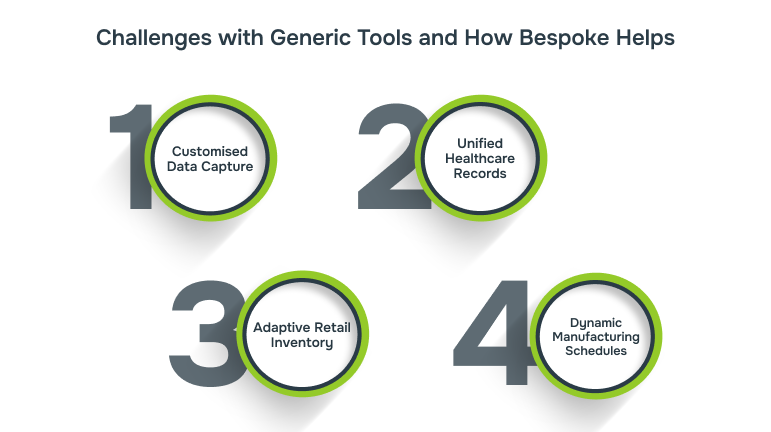
Generic software often slows teams down, with clunky integrations, duplicate data entry, and expensive workarounds every time a process changes. Reflecting this, the UK government and industry committed £300 million to digital manufacturing technologies aimed at boosting productivity by 30%.
The funding backs customised innovations like AI-led design tools and smart automation. Bespoke solutions tackle these issues by starting with the business’s actual workflow:
- Customised data capture: A manufacturer tracking quality checks at different production stages can link results to batch numbers and shift times without forcing data into fields that don’t match. A bespoke setup does it natively, no workarounds needed.
- Unified healthcare records: A custom patient system pulls lab results, appointments, and prescriptions into one view. Clinicians see everything on a single screen and can add notes or updates as they work.
- Adaptive retail inventory: Stock tracking isn’t just about numbers. A bespoke system factors in supplier lead times, order cycles, and seasonal demand so teams know when to restock before shelves go empty.
- Dynamic manufacturing schedules: If materials arrive late or a machine goes down, a custom system reshuffles the production plan automatically. Teams get alerts, downtime drops, and schedules stay realistic.

These examples highlight the gaps that generic tools leave behind and naturally lead to what bespoke IT can deliver beyond standard software.
What Bespoke IT Delivers That Generic Software Can’t
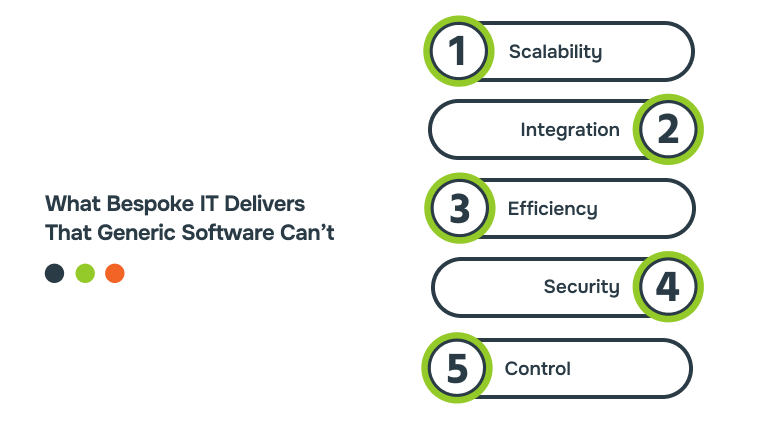
Generic software can feel like trying to fit a square peg into a round hole. It works in theory, but often slows teams down or leaves gaps in their workflow.
Bespoke IT is different because it is built around your business. It grows with you, connects your tools, and puts you in control. Here’s what customised solutions deliver that off-the-shelf software can’t.
1. Scalability
Your system grows as your business does. Adding a new department, product line, or office doesn’t mean switching platforms or paying for features you don’t need. Everything expands naturally because it was built with your growth in mind.
2. Integration
Bespoke solutions integrate your existing tools into a single environment. ERP systems (Enterprise Resource Planning systems), CRM systems, HR systems, and databases all communicate with each other. Teams no longer waste time hopping between apps or exporting files to check data.
3. Efficiency
The right software removes unnecessary steps. If your team spends hours reformatting data or tracking down information across different systems, a custom solution addresses that issue. Workflows become smoother and faster.
4. Security
You decide how data is protected. Encryption, access, and transfer rules are set to your standards, not those of a vendor. GDPR compliance is easier when you control every touchpoint and know exactly where your information lives.
5. Control
Owning the code means you control the roadmap. You aren’t waiting for a vendor to fix a bug or add features. Changes happen on your schedule, and you’re not locked into a subscription that may no longer fit your needs.
Also Read: Managed IT Services: Types, Benefits & Challenges
Understanding these unique advantages shows why a one-size-fits-all approach often falls short in meeting the real needs of a business.
5 Signs Your Business Might Need a Bespoke IT Solution
Sometimes the software you pay for only covers part of what your business actually needs. The rest is handled with spreadsheets, email threads, or manual workarounds. It feels like the tools work in theory but not in practice. Here are some signs your current setup is holding you back:
- You rely on multiple tools: When your data is stored in multiple locations and never matches. Sales numbers in the CRM don’t align with those in finance. Inventory counts are accurate in one system but outdated in another. Reconciling everything takes hours every week.
- Reports are hard to get: Standard dashboards rarely show what leadership actually needs. Custom reports require technical skill to pull and format. By the time the data is ready, decisions have often been made on guesswork.
- Repetitive tasks eat time: Steps that should take seconds are done manually. Employees copy information, double-check entries, or follow multi-step processes that your current software could handle.
- Your tools lack flexibility: Your software cannot adapt to evolving processes. You know certain steps could be automated, but workarounds are the only way to get them done.
- Teams create their own processes: When official workflows are too clunky, employees improvise. This leads to inconsistency, errors, and wasted time.
These signs aren’t just minor headaches; they signal areas where improvements can deliver real, measurable impact.
How to Evaluate the ROI of Custom IT Solutions
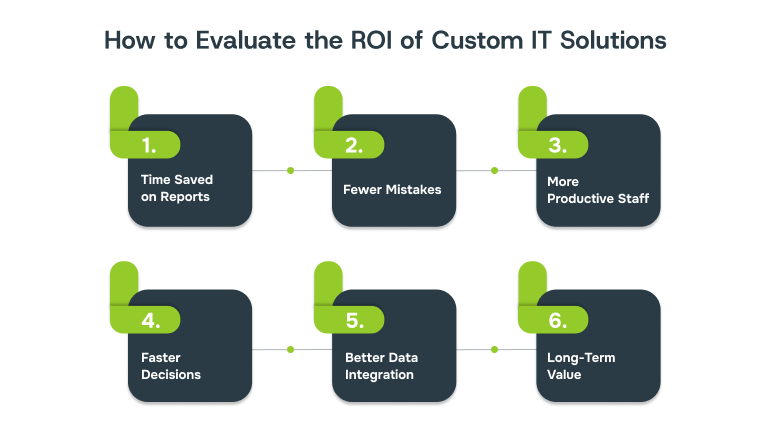
Measuring the impact of bespoke IT solutions involves examining the actual changes that occur after they are implemented. Some results are obvious, like faster reports or fewer errors. Others show up in saved hours or smoother teamwork. Let’s break down the ways you can see real returns:
- Time saved on reports: If compiling reports used to take four hours and now takes ten minutes, that’s a clear, measurable gain.
- Fewer mistakes: Order errors dropping from 3 per cent to 0.2 per cent reduces costs and fixes problems before they grow.
- More productive staff: When people spend less time on repetitive tasks, they can focus on projects that add real value.
- Faster decisions: Real-time performance data lets leadership act quickly instead of waiting days for reports.
- Better data integration: When systems communicate, there are fewer discrepancies, more trust in information, and smoother collaboration.
- Long-term value: You own the platform and it grows with your business. No per-user fees or constant migrations to new tools.
Also Read: Business Process Optimisation: Step-by-Step Guide
Seeing these results in action highlights the real impact bespoke IT can have, and how Alberon helps businesses maintain that efficiency over time.
How Alberon Partners With You to Deliver Custom Software Solutions
Getting the most from bespoke IT starts with the right partner. That’s where we come in. At Alberon, we create customised software solutions that simplify your processes, boost security, and connect seamlessly with the tools you already use.
Here’s how we work together, step-by-step:
- Free Discovery Call: We’ll discuss your current setup and explore your unique workflow challenges.
- Customised Proposal: Next, we put together a clear, customised plan, with a straightforward budget and timeline, made just for you.
- Smooth Transformation: We handle the technical aspects, such as secure setup, easy migration, and ongoing support, so your team can focus on what they do best.
With Alberon, you’re not just buying software. You’re investing in a solution built to fit your business perfectly, so your team can leave tech headaches behind and focus on what they do best.
Conclusion
Bespoke IT solutions help businesses shape technology around how they actually operate, making complex processes easier to manage and decisions clearer. They turn disconnected workflows into coordinated activity without forcing teams to change the way they work.
Working with Alberon helps keep this alignment going beyond implementation. You get systems that stay reliable and evolve with your business, letting you focus on priorities and growth instead of day-to-day technical details.
Get in touch with Alberon to see how your systems can work smarter as your business grows.
FAQs
Q: How do bespoke IT solutions handle regulatory or industry-specific requirements?
A: Bespoke systems can be designed to comply with regulations unique to your industry, ensuring that processes, data handling, and reporting meet legal and compliance standards.
Q: Can a bespoke IT system support multiple locations or international operations?
A: Yes, these systems can be configured to handle different offices, regions, or countries, allowing consistent workflows and centralised oversight without manual adjustments.
Q: How does a bespoke solution affect employee onboarding or training?
A: Custom systems can include built-in guidance, role-specific dashboards, or intuitive interfaces that reduce the learning curve and help new staff become productive faster.
Q: What role does data migration play in implementing a bespoke system?
A: Data from old systems can be carefully imported and mapped into the new platform, ensuring continuity of historical records while reducing errors or losses.
Q: Are bespoke IT systems adaptable to sudden business changes or unexpected demands?
A: Bespoke platforms can be structured to allow flexible configuration, so new workflows, reports, or processes can be added without rebuilding the entire system.
Ready to Improve your Business Productivity
Get a trusted partner to navigate your digital transformation. With Alberon, you can ensure a smooth transition, clear communication, and peace of mind.