
Avoiding Knowledge Silos
When critical knowledge sits with one developer, it creates risk for the entire organisation. This article explores how development teams can use internal documentation, wikis, and structured knowledge sharing to improve collaboration, onboarding, and long-term project stability.

Want to make your Microsoft 365 work harder for your business?
and we’ll tailor a solution that’s just right for you.
Ask any experienced development team what keeps them up at night and you will hear a version of the same story. A developer who built a critical part of the system leaves. No one is quite sure how it works. The documentation, if it exists at all, is out of date. The next time something goes wrong, the team spends days piecing together what should already be written down somewhere.
Knowledge silos are one of the most common and costly problems in software development, and one of the least visible until something breaks. This post looks at why they form, what they put at risk, and what development teams and the businesses that depend on them can do about it.
The Problem with Knowledge Silos
A knowledge silo forms when critical understanding of a system, process, or codebase lives exclusively in the head of one person or a small group. It is almost always unintentional. Developers build features under deadline pressure and document as they go, or more often, document when they have time, which means rarely. Over months and years, the gap between what the system does and what is written down about it widens.
The consequences are not always immediately obvious. The team functions because the person who built a given component is still there. But this creates a hidden fragility. The business is not running on a well-documented system. It is running on the continued presence of specific individuals.
What Undocumented Systems Actually Put at Risk
The risks that come with poor documentation tend to surface at the worst possible moments.
| Scenario: A key developer leaves or is unavailable Systems they built become effectively unmaintainable. Other developers must reverse-engineer behaviour from the code itself, a process that is slow, error-prone, and expensive. |
Internal Documentation Platforms and Wikis
The most effective response to knowledge silos is deliberate, maintained documentation using a platform that makes it easy to write, find, and update information. Internal wikis such as Confluence, Notion, or GitHub’s own wiki features give development teams a shared space that sits alongside the codebase rather than in someone’s inbox or head.
Good internal documentation is not about writing everything. It is about capturing the things that are genuinely hard to reconstruct: why a particular architectural decision was made, how a complex integration works, what the non-obvious gotchas are in a given system, and where to start when something goes wrong.
A system that works in isolation is very different from one that integrates cleanly with a legacy CRM, handles thousands of concurrent users, complies with data regulations, and is readable enough for a new developer to pick up in six months. AI does not hold those requirements in tension. Developers do.
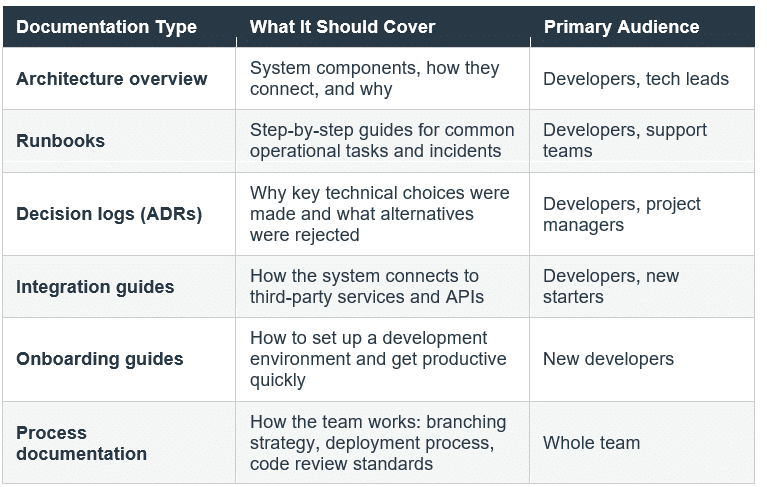
Knowledge Sharing Across Developers and Departments
Documentation is not only about protecting against staff turnover. It is also about making a team more effective day to day. When knowledge is shared rather than siloed, developers can work more independently, resolve problems faster, and cover for each other without bottlenecks.
Cross-departmental knowledge sharing matters too. Non-technical stakeholders, including product managers, operations teams, and senior leadership, benefit from accessible, plain-language documentation that explains what a system does, what its limitations are, and what changes would involve. That kind of transparency builds trust and enables better decision-making across the businesse invisible work that separates software that lasts from software that becomes a liability.
Practical approach Teams that document consistently tend to treat it as part of the definition of done for any piece of work. A feature is not finished when the code is merged. It is finished when the relevant documentation has been updated. That small shift in culture has an outsized effect on the quality of knowledge that accumulates over time.
The Business Benefits of Good Documentation
The case for investing in documentation is not just about avoiding disasters. There are clear, measurable benefits for businesses that get this right.
Documentation as Operational Resilience
Good documentation is an expression of operational maturity. Businesses that take digital transformation seriously eventually arrive at the question of how dependent they are on the tacit knowledge of a small number of people. The answer is usually more dependent than they realised.
For organisations undergoing growth, restructuring, or digital investment, having well-documented systems is not a nice-to-have. It is a prerequisite for scaling safely. It makes audits manageable, acquisitions smoother, outsourcing more viable, and continuity planning realistic.
Development teams that invest in documentation are not just protecting themselves from the problems of today. They are building the kind of institutional knowledge that compounds in value over time. Every new developer who gets up to speed quickly, every incident resolved without escalation, every decision informed by a clear record of what came before, these are the returns on that investment.

Ready to Improve your Business Productivity
Get a trusted partner to navigate your digital transformation. With Alberon, you can ensure a smooth transition, clear communication, and peace of mind.