
Optimizing Dynamics 365 for Lean Manufacturing
Discover how Dynamics 365 supports lean manufacturing by reducing waste, improving flow, and increasing efficiency across operations. Learn how to get started.
Want to make your Microsoft 365 work harder for your business?
and we’ll tailor a solution that’s just right for you.
A factory can run full shifts, but that doesn’t always mean things move smoothly. Orders lag, mistakes appear, and the team struggles to see why. The issue lies in the friction within the process.
Lean manufacturing addresses that by cutting waste and improving flow. It focuses on doing more with what you already have. The results show up on the shop floor every day: faster delivery, fewer errors, and smoother operations.
Microsoft Dynamics 365 supports this by giving teams clear visibility and automating repetitive tasks. It turns data into actionable insight. Businesses using it have reported 85% fewer breakdowns, 40% faster order fulfilment, and over 315% ROI within three years.
This article walks through how Dynamics 365 can make lean manufacturing real. You will see practical ways to reduce delays, align processes, and keep production running efficiently.
Essential Highlights:
- Integrate Lean Manufacturing with Dynamics 365: Connect production, inventory, and supply chain data in one place to reduce delays and simplify coordination.
- Automate and Predict: Use built-in automation and AI tools to cut downtime, trigger maintenance, and keep schedules aligned with demand.
- Apply Core Lean Principles: Map value streams, implement pull systems, and use digital Kanban boards to keep production flow steady and waste minimal.
- Track and Improve Continuously: Use Power BI dashboards and real-time insights to measure performance, find bottlenecks, and sustain ongoing improvement.
Understanding Lean Manufacturing in Modern Production
Lean manufacturing centres on one question: what adds value for your customer? Everything else is waste. At its core, lean rests on five guiding principles that shape how work moves on the shop floor and how digital tools are evaluated. Here’s how they work:
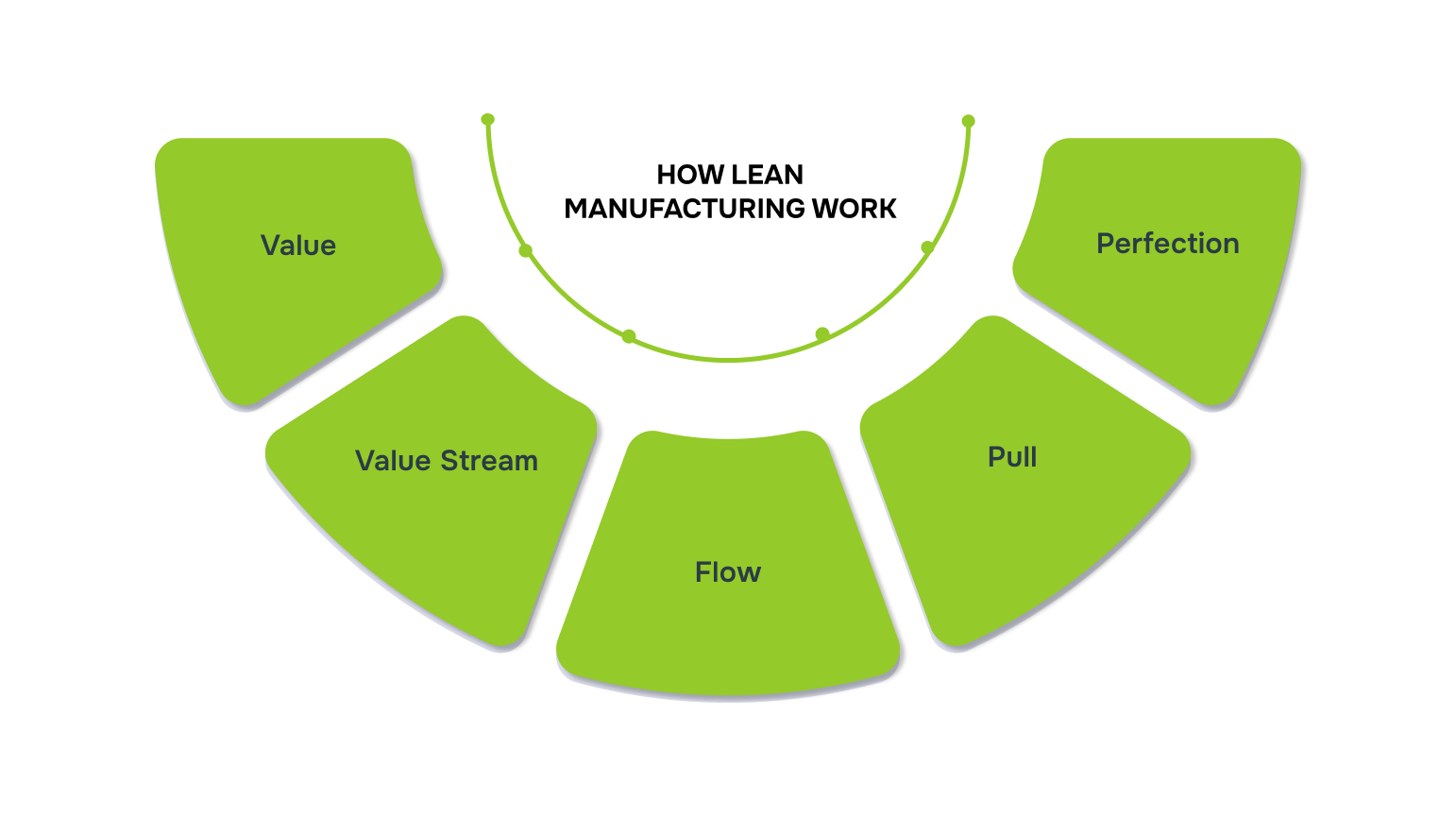
- Value: Identify what the customer actually pays for.
- Value stream: Map every step needed to deliver that value.
- Flow: Keep work moving without interruptions.
- Pull: Produce only when demand signals arrive.
- Perfection: Continuously test, refine, and improve the process.
These principles also guide technology choices. When assessing digital tools, ask whether they expose hidden delays, connect disconnected teams, or help you respond faster to actual orders. Tools that add extra steps rather than reduce friction work against lean goals.
Once the principles are clear, the focus shifts to how they are put into practice on the ground.
How Dynamics 365 Enables Lean Manufacturing
Dynamics 365 brings all your manufacturing data into a single place. Sales, inventory, production schedules, and quality checks are integrated into a single system, reducing the need for emails and repetitive spreadsheet reconciliations.
The platform also automates tasks that used to require manual effort, while AI tools spot patterns and suggest actions that keep operations running smoothly.
Here’s how it supports lean manufacturing in action:
- Automated triggers: Purchase orders initiate when stock reaches reorder points, and production schedules adjust based on incoming orders.
- Real-time alerts: Teams are notified immediately if quality thresholds are missed or schedules change.
- AI insights: The system flags machines needing maintenance, recommends optimal batch sizes, and identifies suppliers who frequently deliver late.
- Module integration: Supply Chain Management, Production Control, Inventory Management, and Quality Management all share data instantly, so decisions are based on the same numbers.
- Silo removal: Everyone sees updates in real time, ensuring faster, coordinated responses across the floor, purchasing, and quality teams.

With these capabilities in place, the focus turns to maximising lean efficiency across your manufacturing operations.
Applying Lean Principles Inside Dynamics 365
Modern manufacturers benefit most when their data and processes are fully integrated, enabling real-time visibility and seamless collaboration across teams. This foundation helps uncover hidden inefficiencies and supports proactive decision-making.
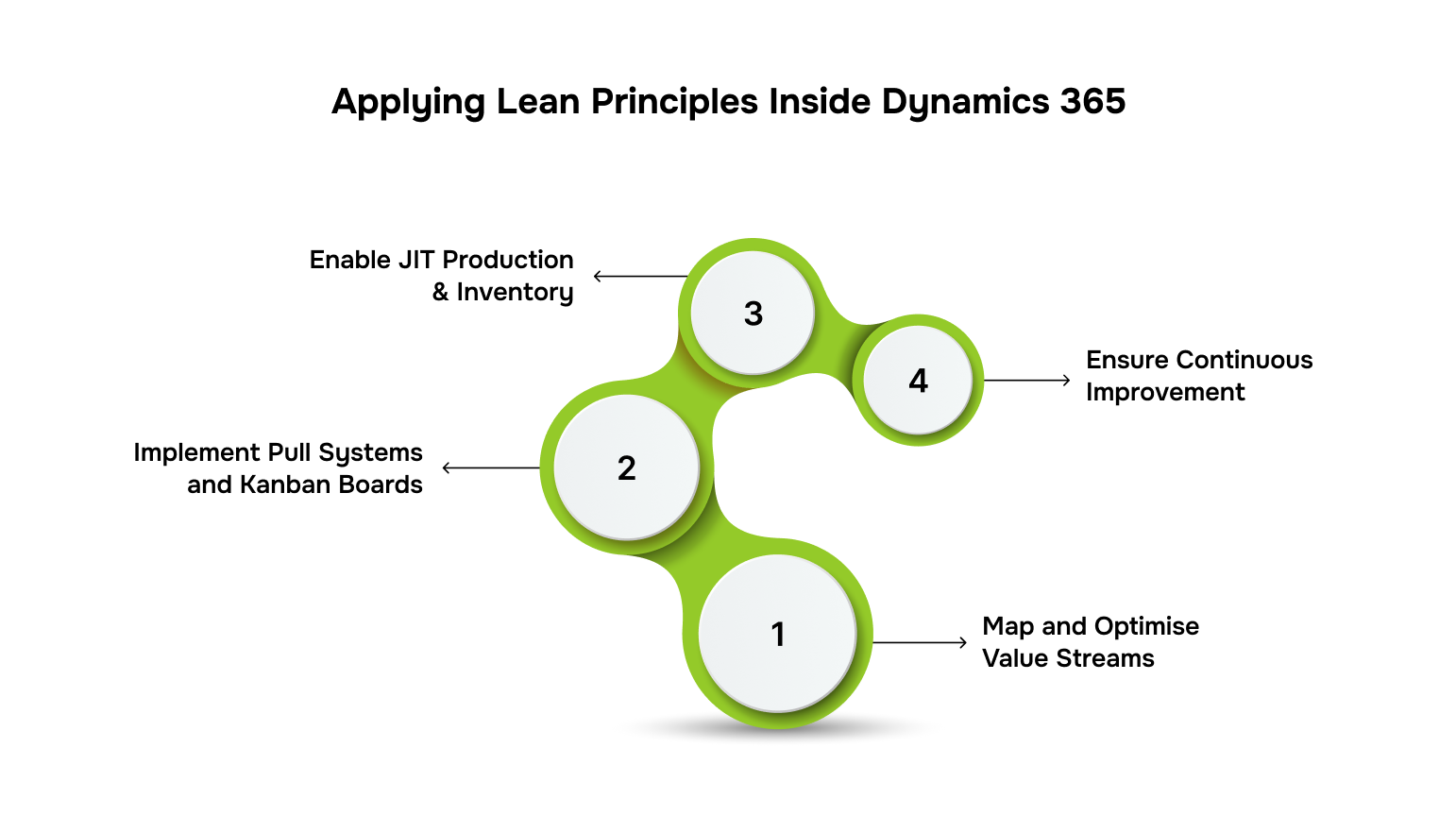
With this alignment in place, let’s explore how to apply Lean Principles inside Dynamics 365.
1. Map and Optimise Value Streams
Start by spotting where time is lost. Dynamics 365 tracks every step from order to shipment, showing idle times, delayed approvals, and slow transitions.
Dashboards make bottlenecks visible, helping you reassign resources, remove unnecessary steps, and consolidate tasks. Metrics update constantly, so you see whether changes actually improve flow.
2. Implement Pull Systems and Kanban Boards
Pull systems prevent overproduction by releasing work only when the next stage signals readiness. Digital Kanban boards show tasks in progress, so teams know what to tackle next without constant check-ins.
Material replenishment is automatic, triggered by actual consumption, keeping stock lean and aligned with demand.
3. Enable Just-in-Time (JIT) Production and Inventory
JIT means producing only what customers need when they need it. Dynamics 365 synchronises schedules with live demand, calculates lead times, sequences work to reduce changeovers, and alerts you to supplier delays. Inventory remains lean because production matches confirmed orders, and the platform tracks everything in real-time.
4. Ensure Continuous Improvement through Insights
Measurement drives lean. Power BI dashboards track KPIs like throughput, defects, and machine usage. AI highlights waste patterns, top-performing shifts, and slow-moving inventory.
Teams use these insights to investigate root causes, implement fixes, and measure results, creating a continuous improvement loop without guesswork.
Now that you’ve seen how lean practices work within Dynamics 365, let’s look at the results they drive.
What Dynamics 365 Delivers for Lean Manufacturers
When Dynamics 365 is applied to lean manufacturing, the impact shows across the entire operation. Lead times shrink because information moves faster than materials. Inventory becomes visible, waste drops, teams stay synchronised, and costs fall.
Agility and scalability improve, while response times to customer requests shorten. Here’s a closer look at what this actually delivers:
- Shorter lead times: Companies often experience significant reductions in order-to-delivery cycles when data flows in real-time.
- Fewer stockouts: Planners know exactly what’s on hand, what’s committed, and what’s incoming, so decisions aren’t based on guesses.
- Reduced waste: Pull systems prevent overproduction, bottlenecks become visible, and quality feedback feeds back immediately.
- Synchronised teams: Production, sales, purchasing, and finance all access the same real-time information.
- Lower costs: Fewer rush shipments, less excess inventory, and reduced overtime for rework.
- Greater agility: Customer priorities shift, and schedules adjust within hours instead of days.
- Scalability without extra overhead: Adding capacity doesn’t multiply administrative work; the platform scales with volume.
- Faster response to customer requests: Delivery dates can be confirmed confidently, and urgent orders are accommodated without disrupting schedules.

However, while Dynamics 365 offers powerful capabilities to support lean manufacturing, successful implementation is critical. Without careful planning, common traps can undermine these benefits.
Lean ERP: What Often Goes Wrong
Companies typically rush into system configuration without first mapping workflows. They assume the system will fix processes, but it won’t. Over-customisation adds maintenance and complexity, so start with Dynamics 365’s lean templates and customise only when essential.
Adoption fails if training comes last, so involve shop floor teams early, show quick wins, and run small pilots. Data issues like inaccurate BOMs or lead times create unreliable outputs, making pre-migration cleanup and ownership crucial.
Begin with Microsoft’s Lean Manufacturing module and pilot one production line to refine the configuration before full deployment. Here’s a clear summary of the main issues and how to address them:
| Common Pitfall | Why It Happens | Recommended Approach |
| Skipping workflow mapping | Assumes ERP will fix processes | Document value streams, identify waste before configuration |
| Over-customisation | Adds maintenance, complicates updates | Use standard lean templates first, customise only for essential gaps |
| Poor workforce adoption | Training is an afterthought | Involve staff early, run pilots, show tangible benefits |
| Data quality issues | Inaccurate master data | Clean data pre-migration, assign ongoing ownership |
| Rushing implementation | Deploying company-wide too soon | Pilot a line or facility first, refine setup using feedback |
| Ignoring Lean module | Building from scratch unnecessarily | Start with Microsoft’s Lean Manufacturing module with preconfigured workflows for JIT, Kanban, and value stream mapping |
With these common challenges and best practices in mind, it’s important to utilise specialised expertise and customised solutions that align with lean manufacturing principles.
Partnering with Alberon for Lean-Focused Dynamics 365 Solutions
A lean setup works only when every system speaks the same language. Alberon helps make that happen by configuring Microsoft Dynamics 365 to connect your CRM, ERP, and production data into a single, unified flow.
Instead of replacing tools, we make your current systems work smarter. Every fix or improvement links back to time, cost, and accuracy because that is what truly drives lean efficiency.
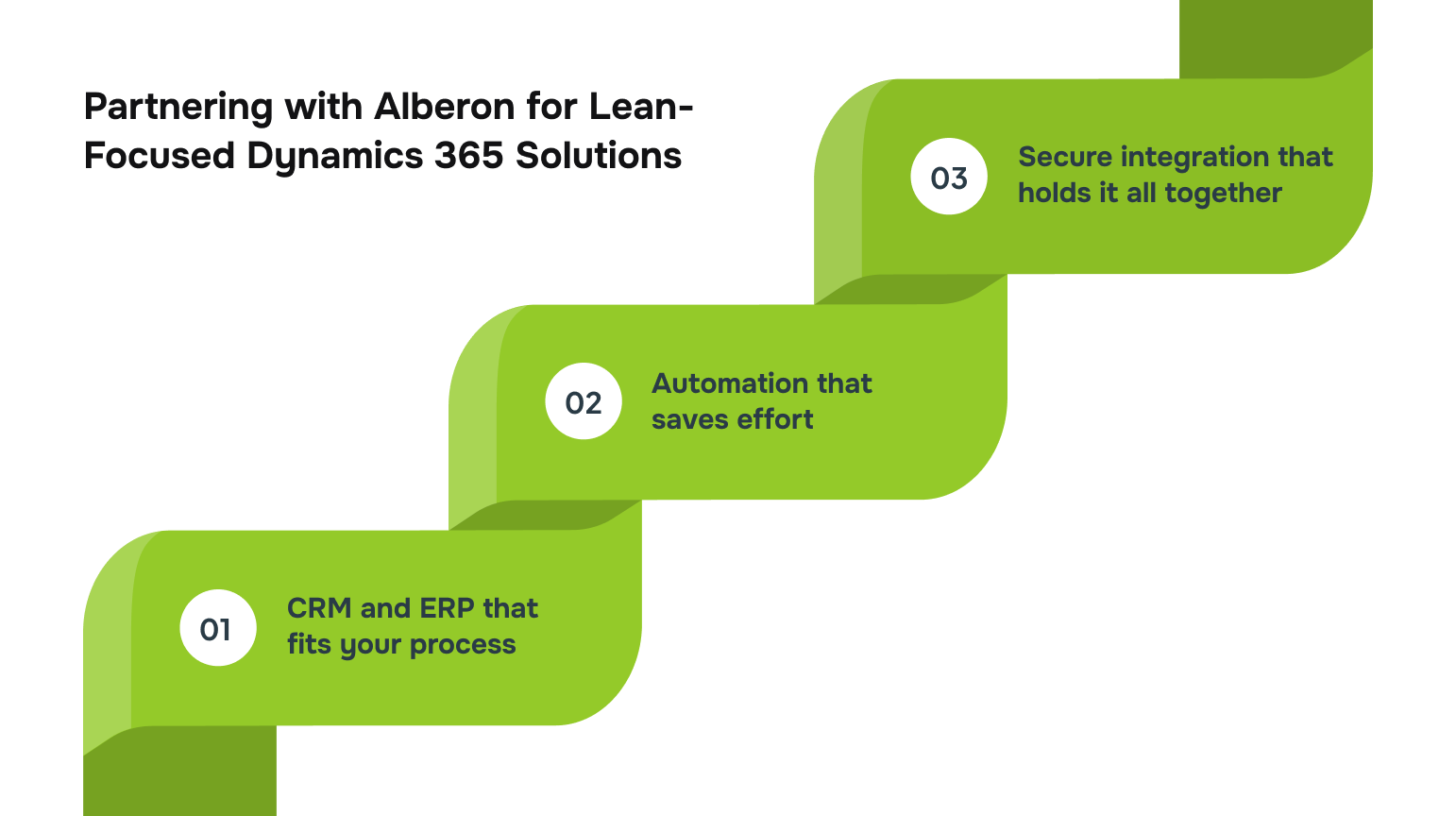
Here is how we help make that happen:
- CRM and ERP that fits your process: We simplify data management so your team can see, share, and act on the right information instantly
- Automation that saves effort: We remove manual tasks and slow approvals so your team can focus on production, not paperwork
- Secure integration that holds it all together: We connect your platforms safely and make sure every part of your operation runs in sync
With Alberon, you are setting up a system built to support lean goals every day. From discovery to implementation, our team stays close, guiding each step so your operations stay stable, efficient, and ready for growth.
Conclusion
Lean practices are most effective when you can respond to change with minimal friction. Small, consistent adjustments in daily routines help build a culture of continuous improvement.
It’s about understanding what each decision means in the broader context. When you can see trends, anticipate challenges, and act with confidence, you set the stage for sustainable growth.
With Alberon, you get structures that support this adaptability. Your systems evolve alongside your operations, making it easier to experiment, learn, and improve over time.
Take the next step and see how Alberon can help your operations adapt and improve with Dynamics 365.
FAQs
Q: How does Dynamics 365 support lean principles?
A: It integrates production data, automates workflows, and connects supply chain insights. This makes it easier to balance demand and resources while cutting downtime and material waste.
Q: Can Dynamics 365 help small manufacturers apply lean methods?
A: Yes. It scales to any setup, offering visibility and automation without complex customisation. Small teams can start with core lean tools and expand as needs grow.
Q: What lean tools are built into Dynamics 365?
A: It includes Kanban boards, production scheduling, demand forecasting, and performance dashboards, all built to track flow and spot waste faster.
Q: How can Alberon help optimise lean manufacturing with Dynamics 365?
A: Alberon helps businesses configure Dynamics 365 to match lean workflows. From setup to reporting, they align system use with value stream goals for smoother, measurable improvement.
Q: Is Dynamics 365 suitable for hybrid production models?
A: Yes. It supports mixed-mode manufacturing, allowing both discrete and lean processes to run in one system with shared data and unified reporting.
Ready to Improve your Business Productivity
Get a trusted partner to navigate your digital transformation. With Alberon, you can ensure a smooth transition, clear communication, and peace of mind.