
Using Dynamics 365 Finance for Efficient Manufacturing
Explore how Dynamics 365 Finance and Operations Manufacturing can boost efficiency, visibility, and control in your operations. Learn more today.

Want to make your Microsoft 365 work harder for your business?
and we’ll tailor a solution that’s just right for you.
Manufacturers implementing Dynamics 365 Finance and Operations achieve an average annual benefit of $20.6 million, with a three-year ROI of 301%. These gains come from connecting financial records with production and inventory data in a single platform that eliminates silos and speeds decision-making.
The impact shows up across operations: 27% increase in manufacturing process automation, 15% boost in production floor productivity, and 85% reduction in unplanned downtime. When finance and operations work from the same real-time data, teams stop chasing problems and start solving them.
This article explores how Dynamics 365 Finance and Operations Manufacturing helps manufacturers cut costs, improve visibility, and make smarter operational decisions.
Essential Highlights:
- Unified Data Flow: Dynamics 365 Finance connects finance and production, so updates happen instantly across both systems for accurate, real-time insights.
- Smarter Cost Control: Built-in cost tracking and capacity planning tools help manufacturers fix inefficiencies early and manage resources proactively.
- Transparent Supply Chain: Live inventory updates and supplier visibility create faster, more reliable material movement and stronger network resilience.
- Predictive Planning: AI forecasting and master scheduling align production with demand, minimising waste, idle time, and stock issues.
- Actionable Automation: Copilot delivers context-based insights and automated prompts, helping teams respond quickly to financial or operational shifts.
Understanding Dynamics 365 Finance and Operations for Manufacturing
Dynamics 365 Finance and Operations runs in the cloud on Microsoft Azure. Manufacturers can choose the modules that match their needs. Each module focuses on specific areas, so teams only use what matters most.
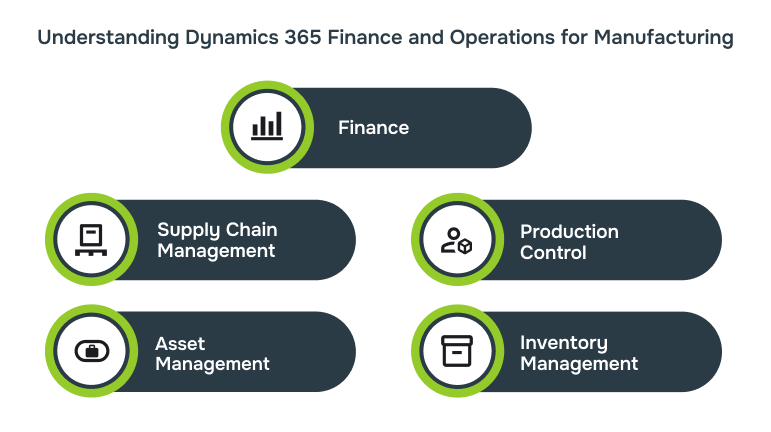
Let’s break down the main capabilities:
- Finance: Manages general ledger, accounts payable and receivable, cash flow, fixed assets, and budgeting.
- Supply Chain Management: Handles purchasing, vendor relationships, and logistics.
- Production Control: Oversees work orders, routing, and shop floor operations.
- Asset Management: Tracks maintenance schedules, equipment costs, and performance.
- Inventory Management: Monitors stock movements and warehouse operations.
Originally, Finance and Supply Chain Management were separate products. Companies could buy one without the other, but manufacturing needs usually require both. Today, they integrate seamlessly, giving a connected view of production and financial activity while still letting businesses choose what fits their setup.
Also Read: What’s New in Dynamics 365 Business Central: 2025 Release Wave 1
These modular capabilities are designed to solve real manufacturing pain points. Before exploring how, let’s look at the core challenges manufacturers face today.
Key Manufacturing Challenges Dynamics 365 Addresses
Manufacturers often face hidden blockers that slow operations and erode profits. These challenges affect stock control, cost tracking, production planning, capacity, and compliance. When these areas aren’t aligned, small issues quickly become bigger problems.
Here’s a closer look at the hurdles teams encounter:
- Inventory inaccuracies: Physical stock drifts from system records. Items go missing, get damaged, or are used without documentation. Decisions based on outdated stock data create downstream delays.
- Hidden product costs: Overhead allocation can be outdated or arbitrary. Without knowing which products incur more indirect costs, pricing decisions are based on guesswork.
- Material shortages: Production schedules sometimes clash with unavailable components. Last-minute orders increase spend and still risk delays.
- Capacity bottlenecks: Unexpected demand spikes can exceed equipment limits. Without insight, turning down orders or overloading lines becomes routine.
- Compliance and traceability gaps: Batch tracking and quality checks take days when data comes from multiple sources. Recall processes become laborious and slow.
Also Read: 7 Proven Benefits of Custom Software for Businesses in 2025
These challenges highlight why a unified platform is crucial and underscore the need to explore how Dynamics 365 Finance and Operations can address them.
How Dynamics 365 Finance Transforms Manufacturing Efficiency
In modern manufacturing, efficiency is no longer just about output. It’s about how quickly a business can turn data into decisions. Microsoft Dynamics 365 Finance brings finance and operations into one intelligent ecosystem, helping manufacturers optimise resources, improve visibility, and respond instantly to market shifts.
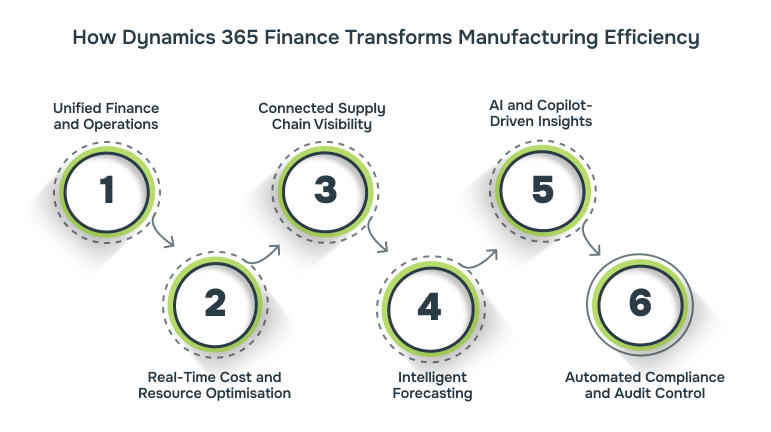
1. Unified Finance and Operations
Manufacturers often deal with disconnected finance and operations, but Dynamics 365 brings them together through a shared data model. Inventory and work-in-progress accounts update instantly as materials move, removing reporting delays. This connection helps cut scrap costs by 10% and speed up order delivery by up to 40%, driving higher profitability.
2. Real-Time Cost and Resource Optimisation
Dynamics 365 Finance tracks standard and actual costs for materials, labour, and overhead in real time, flagging variances before they impact profit. Its capacity planning tools factor in maintenance, labour, and machine use, alerting planners to overload risks early. This helps manufacturers move from reactive cost control to continuous optimisation.
3. Connected Supply Chain Visibility
Warehouse and production teams use live data with instant mobile updates for every item movement, while suppliers see real-time forecasts and orders. This transparency reduces shortages, speeds up lead times, and boosts supply chain productivity by 20%, keeping inventory aligned with demand and production schedules.
4. Intelligent Forecasting and Scheduling
AI-driven forecasting in Dynamics 365 Finance predicts demand using sales and production trends, refined by planners with market insights. Master Production Scheduling turns forecasts into actionable plans that balance costs, efficiency, and delivery timelines, ensuring optimal production with minimal idle time or excess stock.
5. AI and Copilot-Driven Insights
Copilot in Dynamics 365 automates routine work like creating financial summaries and spotting supplier delays. It brings useful insights straight into workflows, helping teams act faster and keep operations smooth.
6. Automated Compliance and Audit Control
Every transaction carries a full audit trail, such as who performed it, when, and from which device. Once a financial period closes, data becomes read-only, ensuring historical integrity. Automated tax and regulatory configurations reduce compliance risks across multiple regions, while statutory reports are generated instantly in the required formats.

Also Read: Dynamics 365 Data Migration: Complete Step-by-Step Guide
Seeing these tools in action shows how day-to-day operations can run smoothly. Next, let’s explore rollout best practices for Dynamics 365.
Best Practices for a Successful Dynamics 365 Rollout
Rolling out Dynamics 365 smoothly depends on practical steps, not just plans on paper. Each decision you make early affects how easily the system supports daily operations. The following table highlights the key focus areas and the benefits of handling them effectively.
| Best Practice | Why It Matters | Expected Outcome |
| Partner Selection | Certified partners understand manufacturing workflows | Faster setup, fewer errors, proven configuration methods |
| Data Cleaning | Removes duplicates and outdated records before migration | Accurate reporting, smoother operations, avoids long-term fixes |
| Change Management | Shows staff how their daily work improves | Higher adoption, less resistance, and practical understanding |
| Configuration Alignment | Matches system setup to manufacturing type | Reduces workarounds, increases efficiency, supports process needs |
Also Read: Steps to Upgrade Dynamics NAV 2018 to Business Central
Even with these best practices in place, executing them correctly can be a challenge. That’s where a dedicated partner comes in to ensure your rollout stays on track and delivers real results.
Alberon: Supporting Dynamics 365 Finance for Manufacturing
Implementing Dynamics 365 Finance can transform manufacturing operations, but it works best when systems and processes are aligned.
Many businesses struggle to connect their existing tools and production workflows to the new platform, which can slow adoption and affect efficiency. This is where Alberon steps in as a partner that ensures the system fits the way your business actually operates.
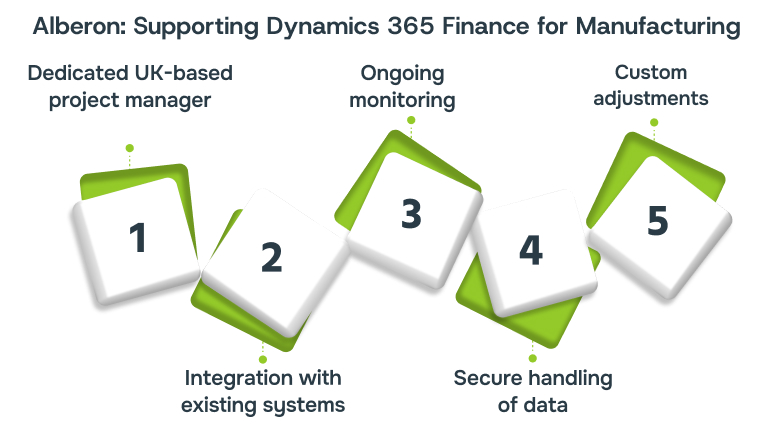
Here’s how Alberon helps manufacturers get the most out of Dynamics 365 Finance:
- Dedicated UK-based project managers who work closely with your team to map requirements, track progress, and keep communication clear.
- Integration with existing systems to connect production, inventory, and finance without disrupting ongoing operations.
- Ongoing monitoring and optimisation to maintain smooth performance and support growth as your operations evolve.
- Secure handling of data in line with GDPR and industry standards, so sensitive information remains protected.
- Custom adjustments to enable features like real-time reporting, cost tracking, and predictive planning to suit your exact manufacturing setup.
With Alberon, you get more than software deployment. You gain a partner who makes sure Dynamics 365 works reliably for your business, improves visibility, and keeps your operations running smoothly.
Conclusion
Manufacturing today requires not just digital tools but clarity in how information flows across operations. Efficient systems help teams understand patterns, anticipate changes, and make coordinated decisions without relying on fragmented reports.
Modernising processes is about creating an environment where every department can see the full picture and respond confidently to shifting priorities.
Bringing this kind of structured oversight to life can be a complex process. Alberon’s UK-based team guides manufacturers through setup and adoption, making sure the system is easy to use, secure, and ready for future growth.
Ready to connect your finance and production workflows? Contact Alberon to implement Dynamics 365 Finance the right way for your manufacturing business.
FAQs
Q: Can Dynamics 365 Finance integrate with non-Microsoft software?
A: Dynamics 365 offers APIs and connectors to integrate with third-party ERP, CRM, or specialised manufacturing software, enabling a broader digital ecosystem without replacing existing tools.
Q: Does Dynamics 365 Finance support sustainability reporting?
A: Yes. The system can track energy usage, waste, and emissions at the operational level, allowing manufacturers to generate reports for internal goals or regulatory compliance.
Q: How does Dynamics 365 Finance track supplier performance?
A: It enables analytics on vendor lead times, delivery accuracy, and quality metrics, giving teams insights into supplier reliability and helping guide strategic sourcing decisions.
Q: Can Dynamics 365 Finance handle multi-currency and global operations?
A: Yes. It supports multiple currencies, tax regimes, and statutory reporting, ensuring global operations comply with local regulations while keeping financial data consolidated.
Q: Is Dynamics 365 Finance suitable for small or pilot manufacturing setups?
A: Its modular design allows small or pilot projects to start with minimal features and scale up as production or operational complexity grows.
Ready to Improve your Business Productivity
Get a trusted partner to navigate your digital transformation. With Alberon, you can ensure a smooth transition, clear communication, and peace of mind.